
March 11, 2019

Don’t Expect an “Average” Market Return in 2019 (Or Any Other Year)

Clete Albitz, CFA, CFP®
Clete Understanding Nua

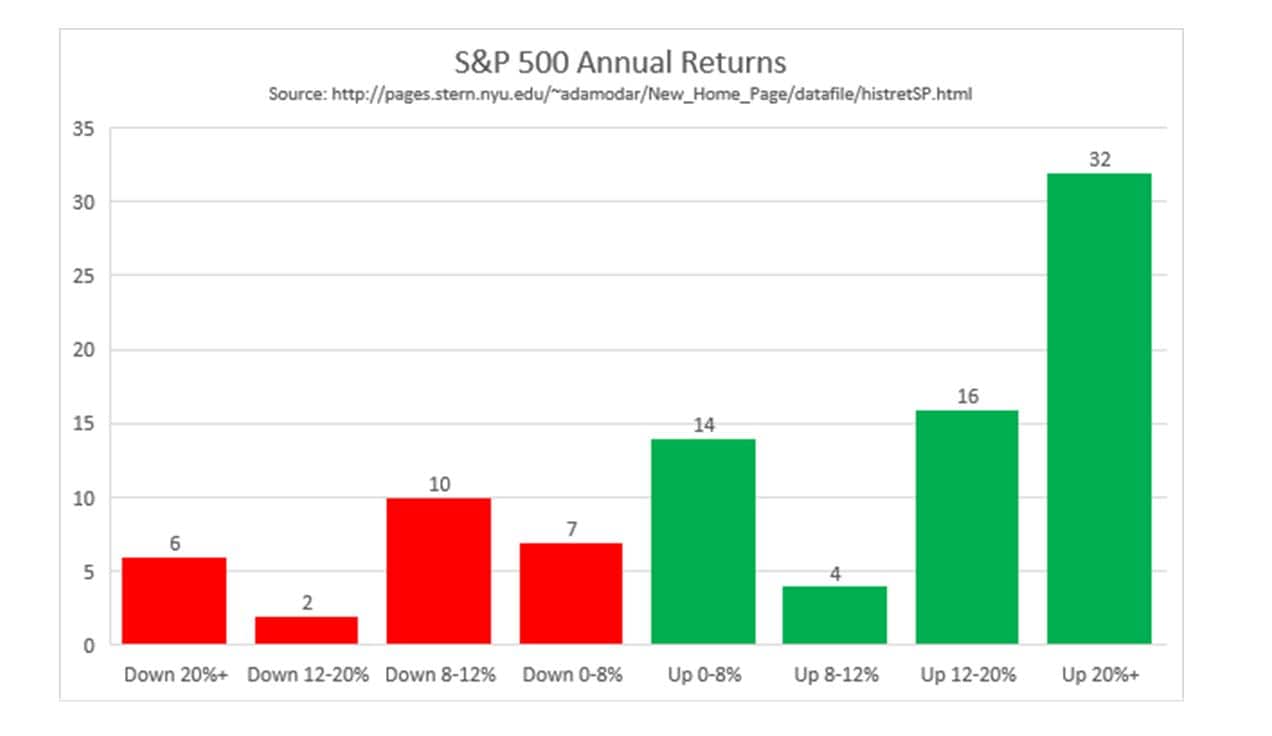
When we hear about annual long-term equity returns, quoted figures typically range between 8 and 12% depending upon the type of equities under evaluation (i.e. large cap vs. small cap, growth vs. value, foreign vs. domestic, etc.). Interestingly, the average return is typically not achieved in any given calendar year. Reviewing historical annual returns of the S&P 500 over the past 91 years (1928 – 2018), the average return is 11.3% – but there have only been four times where the calendar year return has been near it in the 8 to 12% range.  

Surprisingly, historical returns exceeding 20% in a calendar year are far more common than you’d probably expect. In fact, about one-third of the time, returns have exceeded this lofty level. To really have earned the “average” return over this time period, it would have been imperative to capture the returns and remain invested during the 20%+ return years. This is easier said than done as lurking around each corner is the chance of a very bad year – there have been six years where the market declined in excess of 20%.

Determining and matching your investment horizon to your planned use of funds remains key. With the constant news cycle, keeping a long-term perspective can be challenging. When the next down year comes, remember that it is both normal and necessary in order to set the stage for future returns. On the bright side, the general market, as measured by the S&P 500, has been positive over 70% of the time during this period. Although you’re unlikely to earn an “average” return in any given year, the odds remain in favor of the long-term investor.

Sp 500 Annual Returns

Investors cannot invest directly in indexes. The performance of any index is not indicative of the performance of any investment and does not take into account the effects of inflation and the fees and expenses associated with investing. *The S&P 500 Index is a capitalization-weighted index made up of 500 widely held large-cap U.S. stocks in the Industrials, Transportation, Utilities and Financials sectors.

Clete Albitz

CFA, CFP®

Clete Albitz joined Albitz/Miloe & Associates, Inc. in 2005 and is dedicated to serving clients, specializing in investment portfolio management and retirement income planning. Clete is a CFA® charterholder, CERTIFIED FINANCIAL PLANNER®, and graduated with a degree in Economics from the University of California, San Diego. He enjoys playing baseball, basketball, and coaching youth sports. Clete resides in the South Bay with his wife and their three children.

Insights

Enjoy access to our continuously updated library of insights and educational resources.

Screenshot 2026 05

Timely Q & A

A lot of our clients want to know what is meant by the term parabolic rise in a stock price. A parabolic rise is best shown by this illustration.  You get a stock that’s basing, the price just stays stable, goes up and down a little bit, and then some news comes

Trapezemike grandparents 3018410

Understanding IRMAA: What It Is, What It Costs, and How to Appeal It with Form SSA-44

A comprehensive guide for Medicare beneficiaries and pre-retirees navigating the Income-Related Monthly Adjustment Amount What Is IRMAA? If you’re enrolled in Medicare and your income exceeds certain thresholds, you’re paying more for your coverage than most beneficiaries — possibly a lot more. The additional charge is called IRMAA, which stands for Income-Related

Tungart7 ai generated 8715598

Parental Down Payment Assistance: The Business of Structuring Gifts vs. Family Loans

Current data indicates a bifurcated reality for first-time home buyers: while many secure properties independently, high upfront capital requirements necessitate parental financial intervention for a large segment of the market. For parents with the means, providing down payment assistance is a significant way to facilitate this milestone. However, the mechanism of that