August 29, 2019

Market Volatility Returns, but Never Really Left

Clete Albitz, CFA, CFP®
Intra Year Declines Vs. Calendar Year Returns

It is estimated that 75% of daily trading volume is the result of automated computerized trading and equity prices seem to be more volatile today than ever. However, volatility is nothing new, and if you find yourself paying too much attention to the noise of short-term price action, one simple way to minimize volatility is to “not look so much”. Keeping a long-term perspective may be cliché but remains important as an investor.

Relatively large price swings in the equity markets are normal. Since 1980, as measured by the S&P 500, more than 50% of all years have been subject to a double-digit market correction with the average intra-year decline being 13.9%. During these times, assuming you have already set aside funds for current and upcoming cash needs, you’ll want to do your best to stay calm, and remember that we don’t own equities because we like risk and volatility, but do so because they provide higher long-term returns needed to meet important financial goals.

Over the same timeframe, calendar year returns were positive over 75% of the time with the average annual return being over 8% per year. By setting and keeping proper expectations about what will likely happen to your investment’s value over a market cycle, you can better gain or keep the resolve to remain invested. History has shown that investors who can do so are well rewarded over time.
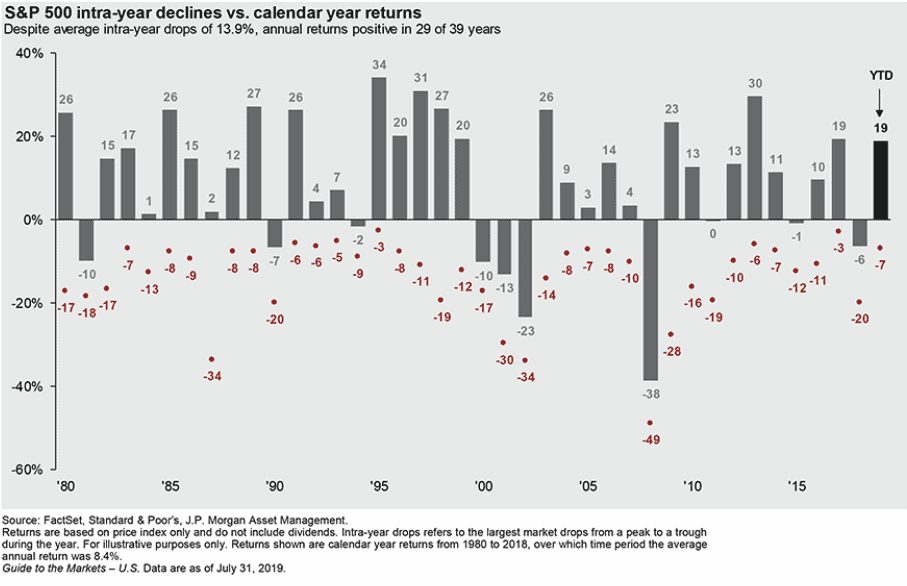

Intra Year Declines Vs. Calendar Year Returns

The views stated in this letter are not necessarily the opinion of Cetera Advisor Networks LLC and should not be construed directly or indirectly as an offer to buy or sell any securities mentioned herein. Due to volatility within the markets mentioned, opinions are subject to change with notice. Information is based on sources believed to be reliable; however, their accuracy or completeness cannot be guaranteed. Past performance does not guarantee future results. Investors cannot invest directly in indexes. The performance of any index is not indicative of the performance of any investment and does not take into account the effects of inflation and the fees and expenses associated with investing.

Clete Albitz

CFA, CFP®

Clete Albitz joined Albitz/Miloe & Associates, Inc. in 2005 and is dedicated to serving clients, specializing in investment portfolio management and retirement income planning. Clete is a CFA® charterholder, CERTIFIED FINANCIAL PLANNER®, and graduated with a degree in Economics from the University of California, San Diego. He enjoys playing baseball, basketball, and coaching youth sports. Clete resides in the South Bay with his wife and their three children.

Insights

Enjoy access to our continuously updated library of insights and educational resources.

1Phil Blog Article October

Under the Big Top

Hi everybody, I hope you had a great summer. Today I’m going to talk about something that’s been in the news quite a bit and, to an extent, what is driving the financial markets right now. Yes, we know about the upcoming midterms, the geopolitical chaos and the worries about AI running

Vance Screenshot 2026

Retirement Doesn’t End Your Paycheck. Here’s How to Build Your Own.

For forty years, a paycheck showed up every two weeks. When you retire, the paycheck doesn’t have to end, but you have to build the new one yourself. This article covers how we do that, and why it can feel harder than people expect. Two kinds of security While you’re working, your

1 22594 calculator 1516869

Taxes, Taxes, Taxes

Income and Payroll Taxes Have you ever looked deeper into all the taxes you pay? While tax discussions typically focus on the major players of Federal and State income tax, looking deeper can be eye opening. Since rates can vary by income, let’s consider an individual in CA making $100,000 per year.